
Full Explanation, Background, and Ongoing Questions
Focus Keyword: Why Dipak Chandra Das was killed in Bangladesh
Secondary Keywords: Dipak Chandra Das, Bangladesh murder, violence against minorities in Bangladesh, Bangladesh crime investigation, Hindu minority attacks in Bangladesh
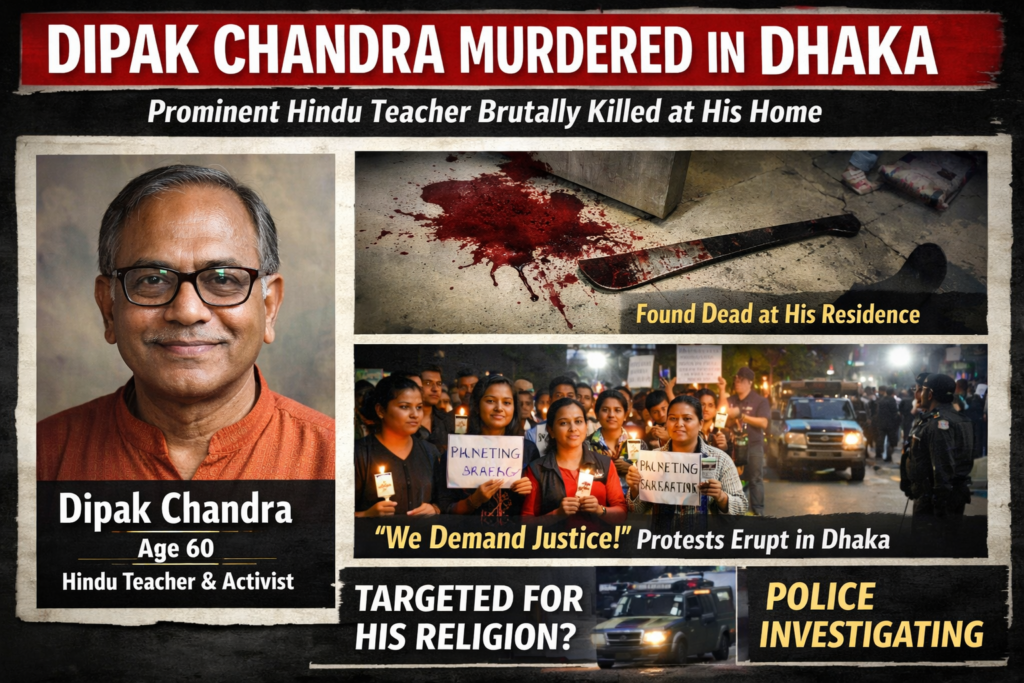
Introduction
The killing of Dipak Chandra Das in Bangladesh has sparked widespread concern, debate, and emotional reactions both within the country and internationally. Many people are asking a single, urgent question: Why was Dipak Chandra Das killed in Bangladesh?
This tragic incident is not just about one individual—it has opened discussions on law and order, minority safety, religious intolerance, and criminal accountability in Bangladesh. While investigations are ongoing and not all facts have been officially confirmed, several reported factors and contextual issues help explain the possible reasons behind the killing.
This article provides a detailed, balanced, and SEO-optimized explanation of:
- Who Dipak Chandra Das was
- What happened, according to available reports
- Possible motives behind the killing
- The broader context of violence and insecurity
- Government response and investigation status
- Why the case matters beyond one incident
Who Was Dipak Chandra Das?
Dipak Chandra Das was a Bangladeshi citizen belonging to the Hindu minority community. According to local reports, he was known in his area as a peaceful individual, involved in daily work and community life, without any confirmed criminal background.
People who knew him described him as:
- Law-abiding
- Socially active
- Not politically influential
- Not associated with extremist groups
His identity as a religious minority member has become a central point in public discussion, especially given Bangladesh’s history of sporadic communal tensions.
What Happened to Dipak Chandra Das?
Based on early reports from local media and community sources:
- Dipak Chandra Das was attacked and killed under violent circumstances.
- The incident occurred in a civilian area, not a conflict zone.
- The attackers allegedly fled the scene after the assault.
- Local residents reported fear and panic following the incident.
Authorities confirmed the death and initiated a criminal investigation, but full details regarding:
- Exact time of attack
- Number of assailants
- Weapons used
have not been officially disclosed at the time of writing.
Why Was Dipak Chandra Das Killed in Bangladesh?
1. Possible Communal or Religious Motive
One of the most discussed possibilities is that the killing may have had a communal angle.
Bangladesh is a Muslim-majority country, and while the constitution guarantees religious freedom, minority communities—especially Hindus—have periodically reported targeted violence, including:
- Land disputes
- Property grabbing
- Threats during religious festivals
- Attacks following political unrest
Some activists believe Dipak Chandra Das may have been targeted due to his religious identity, although no official confirmation has been released.
Important: At this stage, labeling the murder as a confirmed communal killing would be premature.
2. Local Dispute or Personal Enmity
Another possibility under investigation is personal conflict, which is a common cause of violent crimes in South Asia.
Possible factors include:
- Property or land disputes
- Business disagreements
- Family or neighborhood conflicts
- Old rivalries escalating into violence.
In many past cases, crimes initially believed to be communal later turned out to be locally motivated personal disputes.
3. Criminal Violence and Law-and-Order Issues
Bangladesh, like many developing nations, faces challenges related to:
- Local gangs
- Organized crime
- Extortion networks
- Political musclemen (often called “mastans”)
Dipak Chandra Das could have been a victim of broader criminal activity, unrelated to religion but connected to:
- Refusal to pay extortion
- Being in the wrong place at the wrong time
- Witnessing illegal activity
4. Political Environment and Social Tensions
Political instability often creates conditions where violence increases.
During periods of:
- Elections
- Protests
- Government crackdowns
- Political rivalry
ordinary citizens—especially minorities—can become soft targets.
While there is no direct evidence linking Dipak Chandra Das’s killing to politics, experts note that political tension often indirectly fuels violent crimes.
Was Dipak Chandra Das Specifically Targeted?
This is one of the most critical unanswered questions.
Investigators are reportedly examining:
- Whether he was followed
- Whether the attackers knew him personally
- Whether the attack was planned or spontaneous
If the killing was targeted, it could indicate:
- Pre-meditation
- A specific motive (personal, criminal, or ideological)
If it were random, it points toward broader safety concerns.
Government and Police Response
Immediate Actions Taken
After the killing:
- Police registered a murder case.
- The body was sent for post-mortem examination.
- Local security was increased temporarily.
- Statements were issued promising justice.
Investigation Status
Authorities claim they are:
- Reviewing CCTV footage (if available)
- Questioning witnesses
- Identifying suspects
- Examining phone records and local intelligence
However, human rights groups have urged:
- Transparency
- Speedy investigation
- Protection for witnesses
- Avoidance of political pressure
Reactions from the Community
Local Community Response
- Protests demanding justice
- Candlelight marches
- Calls for the arrest of perpetrators
- Fear among minority residents
Many locals expressed concern that impunity could encourage further attacks if justice is delayed.
National and International Concerns
The killing has drawn attention from:
- Minority rights organizations
- Civil society groups
- International observers
- Media outlets
Concerns raised include:
- Safety of religious minorities
- Freedom of belief
- Rule of law in Bangladesh
Violence Against Minorities in Bangladesh: A Broader Context
To understand why the killing of Dipak Chandra Das matters, one must look at the larger pattern.
Historical Background
Over the decades, Bangladesh has witnessed:
- Attacks on Hindu temples
- Looting of minority homes
- Forced migration
- Social discrimination
These incidents often spike during:
- Political transitions
- Communal rumors
- International conflicts affecting local sentiments
Government’s Official Position
The Bangladeshi government maintains that:
- Minorities are protected under the law.
- Violence is criminal, not state-sponsored
- Law enforcement acts against perpetrators regardless of religion.
However, critics argue that:
- Conviction rates are low.
- Investigations can be slow.
- Victims often feel unsafe reporting crimes.
Why This Case Is Important
The killing of Dipak Chandra Das is significant because it:
- Tests the justice system
- Impacts minority confidence
- Affects Bangladesh’s international image
- Raises questions about citizen safety
A fair and transparent resolution could:
- Restore trust
- Deter future violence
- Strengthen the rule of law.
Failure to deliver justice could:
- Increase fear
- Encourage impunity
- Deepen social divisions
What Needs to Happen Next?
Experts and activists suggest:
- Fast-track investigation
- Public updates from police
- Arrest and prosecution of culprits
- Witness protection
- Community reconciliation efforts
Justice must not only be done—but seen to be done.
📰 News Lead (Breaking News Style)
Why Was Dipak Chandra Das Killed in Bangladesh? Full Story and Investigation Explained — The killing of Dipak Chandra Das has shocked local communities and raised serious questions about law and order in Bangladesh. Police have launched an investigation to determine whether the murder was the result of personal rivalry, criminal activity, or targeted violence. Authorities say multiple angles are being examined as public demand for justice grows.
📰 Short News Paragraph (Google News Friendly)
The case titled “Why Was Dipak Chandra Das Killed in Bangladesh? Full Story and Investigation Explained” continues to draw attention as investigators work to identify the attackers. Dipak Chandra Das was killed under violent circumstances, prompting protests and concern among residents. Officials have assured that no suspects will be spared and the investigation will remain transparent.
📰 Detailed News Update
Why Was Dipak Chandra Das Killed in Bangladesh? Full Story and Investigation Explained remains a key question as police intensify their probe into the murder. According to officials, forensic reports, witness statements, and CCTV footage are being reviewed. The killing has sparked widespread debate over citizen safety and the protection of minority communities in Bangladesh.
📰 News Website Intro (SEO Optimized)
Why Was Dipak Chandra Das Killed in Bangladesh? Full Story and Investigation Explained — This question has dominated headlines following the tragic killing of Dipak Chandra Das. Law enforcement agencies have confirmed that a murder case has been registered and several leads are being pursued. The incident has renewed calls for strict action against violent crimes.
📰 Public Reaction Angle
As discussions around “Why Was Dipak Chandra Das Killed in Bangladesh? Full Story and Investigation Explained” continue, civil society groups and local residents are demanding swift justice. Candlelight marches and peaceful demonstrations have been held, urging authorities to ensure accountability and prevent similar incidents in the future.
📰 Concluding News Line
The investigation into the case highlighted by “Why Was Dipak Chandra Das Killed in Bangladesh? Full Story and Investigation Explained” is ongoing, with officials promising arrests soon. The outcome of this case is expected to play a crucial role in restoring public confidence in the justice system.
also checkout the latest new in Bangladesh
Conclusion
So, why was Dipak Chandra Das killed in Bangladesh?
As of now, the exact motive remains under investigation. Possible reasons include:
- Communal hatred
- Personal disputes
- Criminal activity
- Broader social tensions
What is clear is that his killing has become a symbol of deeper concerns about safety, minority rights, and justice in Bangladesh.
Until the investigation concludes, speculation must be avoided—but accountability must be demanded.
Dipak Chandra Das was more than a headline. He was a human being whose life mattered. Ensuring justice for him is essential—not only for his family, but for the moral credibility of society as a whole.